



Coral Reefs
Hidden beneath the Earth's tropical seas, coral reefs are enormous underwater cities. They are built by tiny coral polyps and inhabited by millions of fascinating creatures. Coral reefs are unlike anything on land. They are the biggest biologically-built structures on earth.
Located in warm, shallow seas, coral reefs are enormous, rocklike structures, but unlike mountains, deserts, and most other natural landscapes, a coral reef does not consist of rock and soil. Instead it is a huge city built by tiny animals called coral polyps. Even fully-grown, most coral polyps are smaller than a fingernail.
A coral polyp has a soft body, stomach and mouth surrounded by tentacles. Although reef-building polyps are animals, they cannot move around like other animals. Each polyp uses minerals from seawater to build a limestone skeleton., which cements it to the seafloor. Known as Stony Corals, these polyps sacrifice mobility for security. When disturbed, the soft-bodied polyp ducks into the protection of its hard, rocklike home.
Polyps, like people, live close together in colonies. As polyps grow, they move up to build new skeletons on top of the old. And very slowly, over many years, the reef grows with them. Some colonies contain millions of individual polyps.
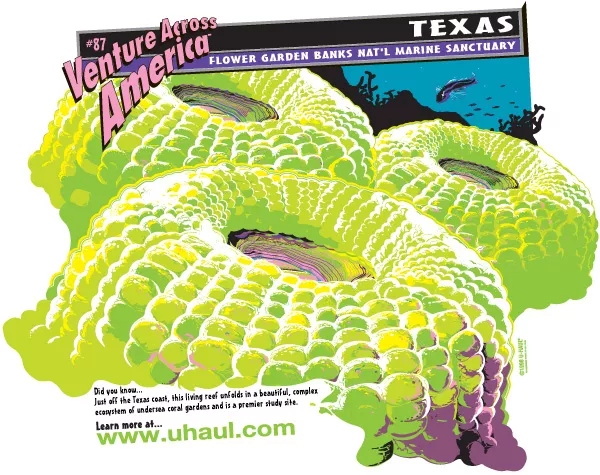
The shape of a colony depends on the species of coral. Some colonies look like big boulders, while others grow in the shape of tree branches or deer antlers. Still other colonies resemble large plates or shelves. There are even colonies that look like human brains.
Over time coral colonies establish themselves, grow and eventually die. But even after a colony dies, the polyps' hard limestone shelters remain. In time, a new coral colony establishes itself upon the skeletons of its ancestors. It's like a modern city built upon the ruins of an ancient civilization. Thus, over many hundreds of years, countless generations of polyps slowly produce a jumble of limestone boulders, branches, and shelves a coral reef.
Coral reefs do not arise just anywhere. Reef-building polyps need sunlight, warm water, abundant food and fixed levels of salt and oxygen. The only places where all these conditions are met are in tropical regions of the Earth. As a result, living coral reefs are found only in clear, shallow (generally less than 150 feet) water near the Earth's equator.
A world map that shows where reefs occur reveals an odd pattern: almost no reefs on the western coasts of continents. This is the result of cold ocean currents. About 60 percent of all coral reefs are found in the Indian Ocean, including the Red Sea. A quarter of all reefs grow in the Pacific Ocean and the rest occur mostly in the Caribbean.
Coral reefs are generally defined by their overall structure and the geological conditions under which they evolved. No two coral reefs are alike, but most marine scientists agree that there are five basic types: fringing reefs, barrier reefs, Atolls, bank reefs and patch reefs.
Fringing reefs grow along coasts or around islands that have a sharp drop-off to deep water near their shores. Most of the corals grow near the edge of the drop-off. A lagoon of shallow water, called a reef flat lies between the fringing reef and the land. They are common around most Caribbean and Bahamian islands, but are virtually absent along both Florida coasts and the Florida Keys. Geologically they are considered to be the youngest type of reef.
Barrier reefs also develop along the edges of islands or continents, but usually are farther from land than fringing reefs. They are separated from the land by a wide, deep lagoon. These reefs usually stretch for many miles and form unbroken barriers that slow the ocean's powerful waves. The best example in the Western Hemisphere is the world's second longest, skirting the small Central American country of Belize. Typically fringing refs change to barrier reefs when their associated landmass undergoes a slow geological sinking.
The largest coral reef in the world is the Great Barrier Reef, which stretches for more than 1200 miles along the coast of Australia. It is the world's largest structure built by living organisms, including humans. It is the only living organism that can be see from space.
Atolls are isolated rings of coral. Unlike other reefs, atolls are usually located far from land, surrounded by nothing but water. Since coral polyps cannot survive in deep water, these isolated rings of coral puzzled scientists for many years. We now know that Atolls begin when a volcano erupts from the ocean floor. After it reaches the surface, a fringing reef grows around it.
Over many thousands of years, the seafloor sinks from the weight of the dormant volcano, which is also eroded away by rain and waves. As the volcano slowly sinks beneath the surface of the ocean, the coral polyps grow fast enough to keep the top layer of the reef near the ocean's surface. Given enough time, some atolls develop into islands made entirely of coral. Atolls are generally found in the tropical Pacific.
Bank reefs are open sea reefs. They are surrounded by deep water and have no central lagoon. They are generally many miles from land.
Patch reefs are small areas, or patches, of isolated reef. They generally occur between fringing reefs and barrier reefs.
Prehistoric Reefs The earliest forms of hard corals lived in warm shallow seas about 450 million years ago. The remains of reefs they built in shallow seas are sometimes found far inland. Geologists have discovered evidence of coral reefs in Illinois, Indiana, and Wisconsin. About 250 million years ago, a large barrier reef thrived where west Texas is now. In the foothills of the Italian Alps, scientists have found the remains of corals and many fossil fish that lived about fifty million years ago.