


Habitats
The Flower Garden Banks National Marine Sanctuary is an intriguing blend of habitats, harboring a tantalizing array of creatures, great and small.
Pelagic Zone
As
you begin your descent through the water column into this unspoiled
wilderness, you are passing through the pelagic zone. Here, you find
those species that survive by cruising from place to place in search
of a meal or a mate. You may encounter such charismatic characters
as manta and spotted eagle rays, hammerhead and silky sharks, the
ubiquitous chub, loggerhead sea turtles, jack crevalle, amberjack
and, if you are really lucky, a whale shark.
Just below 50 feet, you encounter the shallowest portions of the high diversity reef habitat, which continues to depths of around 100-120 feet. As you explore over 300 acres of marvelous high relief reefs, you discover that they include the majority of the species found at the Flower Gardens: 21 corals, over 250 reef invertebrates, 175+ fish, and 80 species of marine algae. For still unknown reasons, there are no elkhorn or staghorn corals, and no shallow water sea fans or sea whips, all of which can be found on other Caribbean and Gulf of Mexico reefs.
Below 90 feet on the high diversity reef, you will also see, nestled among the larger corals, ridges or knolls with high concentrations of the small, branching finger coral Madracis mirabilis. These unusual thickets also feature finger sponges, encrusting sponges and algae. The Madracis ridges are also found scattered around the low diversity reef habitat.
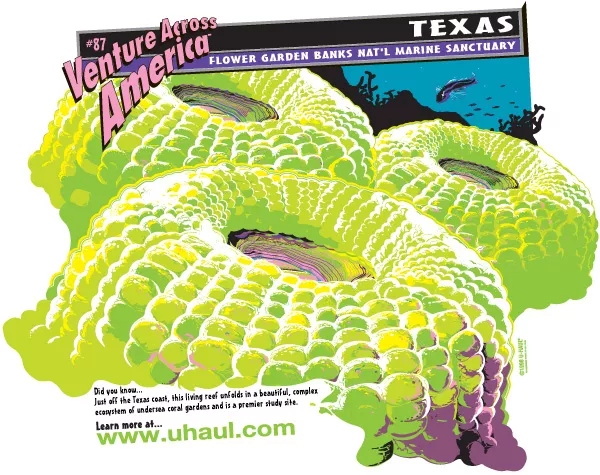
The most obvious organisms in the high diversity reef habitat are the massive boulder-shaped coral colonies. Many have been sculpted into mushroom shapes by a process called bioerosion, in which other organisms gradually wear away the colony around its base. Available space created by bioerosion and breakage is quickly colonized by algae, sponges and other attaching organisms. The dominant coral species are the mountainous star coral (Montastraea sp) and the brain coral (Diploria strigosa).
Low Diversity Reef
To examine the low diversity reef
habitat, you must venture below 120 feet into water as deep as 170
feet, not advisable for the average recreational diver. At these depths,
corals grow in a flattened manner to maximize their exposure to light,
a critical element of life to the symbiotic algae living in the corals'
tissues. Habitat relief is much lower than on the shallow reefs. Fewer
corals live in this zone, primarily because most species need more
light. The dominant species are a star coral (Stephanocoenia michilini)
and fire (Millepora alcicornis).
Algal-Sponge
At
about 150 feet, you will begin seeing the algal-sponge habitat, which
extends to around 270 to 290 feet deep. Dominated by coralline algae,
this habitat covers several square miles, a much larger area than
is inhabited by corals. Algal nodules up to fist size cover 50 to
80 percent of the bottom in places. Because of the area covered and
the amount of carbonate deposits produced, the algae may be more important
to reef formation, overall, than corals are on the banks. Although
less is known of the biota in this habitat, some believe that the
species diversity may be comparable to that on the coral reefs.
The lower two-thirds of the algal-sponge habitat begin a transition zone between organisms that exhibit distinct shallow-water traits and those adapted to deep water. A distinctive transition species is the white, bedspring-shaped, antipatharian sea whip.
Base
At their bases, the banks are surrounded
by mostly unvegetated sand or mud bottom. While many believe these
areas to be barren, closer examination reveals a healthy community
of organisms living on and within the sediments. Microalgae, a variety
of worm species, crabs and sea stars are examples of the organisms
inhabiting these areas.
Underwater Salt Lake
If
you were exploring the southeast flank of the East Bank, 220 feet
down you would discover an unusual underwater salt lake almost 200
feet wide and only 10 inches deep. Fed by a brine seep from the underlying
salt dome, the lake is highly saline, has high levels of hydrogen
sulfide and dissolved hydrocarbon gases, and no oxygen--not exactly
what we think of as ideal living conditions for most organisms! The
lake flows into a canyon that allows mixing to occur.
This dilutes the brine, adds oxygen and reduces the toxic hydrogen sulfide. So much salt has dissolved from beneath the bank that a large depression, known as a graben, has formed. The graben is more than a mile across and 15 feet deep.
A unique assemblage of biota has developed in and around the lake and in the canyon. Dominant organisms are sulfide-oxidizing bacteria, living at the very thin interface between the dense brine lake and the normal seawater above. A white mat of bacteria and algae covers the floor of the canyon. A specialized community of organisms, called thiobios, inhabit the sulfide-rich canyon stream and feed directly on the plants and bacteria growing there. Most fish cannot tolerate the sulfide of the canyon brine stream, but some are able to take advantage of the food source there by diving into it for quick meals.