



Introduction
From the beach, the Gulf of Mexico looks like a large body of water with a few ships and drilling platforms dotting the horizon. But what you don't see may be one of Nature's best kept secrets.
It's hard to imagine, but 100 miles out into the Gulf of Mexico, south of the Texas-Louisiana border, where the water is deep blue and crystal clear, you'll find an underwater wonderland that is home to hundreds of species of tropical fish and colorful marine plants and animals. It is a place where once a year the living sea floor erupts into a synchronous display of reproduction. A place that fascinates scientists and sport divers alike.
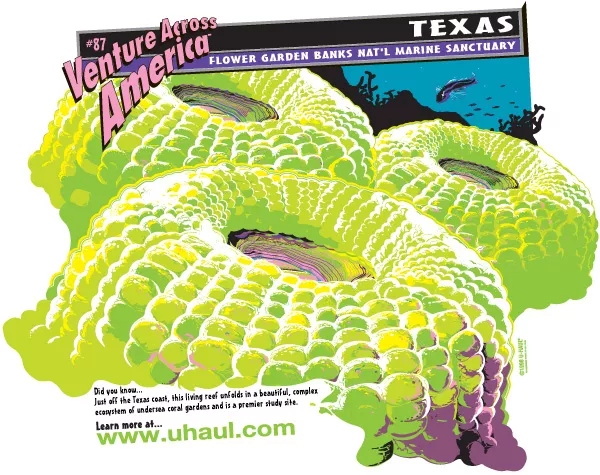
Within the last 20,000 years, Caribbean currents carried tiny coral larvae to these shallow areas. Coral colonies began to grow on top of two undersea mountains. And because of the rapid growth of marine plants and animals, no trace of the bedrock at the Flower Gardens can be found. It's now covered by healthy, thriving tropical reef communities.
The Flower Garden Banks Marine Sanctuary consists of the East and West Banks, which are 12 miles apart, and Stetson Bank, located 30 nautical miles north of the Flower Gardens.
The East Flower Garden Banks is a pear-shaped dome approximately three miles in diameter that rises to within 55 feet of the sea's surface. The total area of the coral reef atop the dome is about 300 acres.
The West Flower Garden Banks is an oblong shape, about 6-1/2 miles long and five miles wide and rises to within 60 feet of the sea's surface. The live reef on top of the dome covers little more than 100 acres.
Stetson Bank is not a coral reef; its unique formation consists primarily of silkstone and claystone, brought to the ocean floor by an underlying salt dome and dominated by sponges and fire coral.
Amazingly, this location in the northwestern Gulf provided all the comforts of home for hard corals: a hard surface for attachment, clear sunlit water, warm water temperatures, and a steady food supply. The corals now form the basis for a complex yet balanced ecosystem, providing a regional oasis for shallow-water Caribbean reef species.
It was this wonderful biological diversity and breathtaking beauty that prompted researchers and recreational divers to seek protection for the Flower Gardens. They launched what would become a 20-year effort, culminating in 1992, to designate the Flower Garden Banks National Marine Sanctuary. In 1996, Stetson Bank was added to the sanctuary.