


Free at last
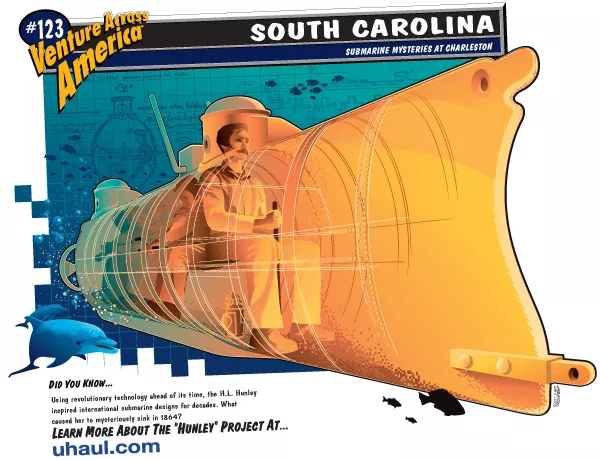
The state of South Carolina created the Hunley Commission to acquire, recover and preserve the H.L. Hunley for public display. The Friends of the Hunley was created by the Hunley Commission to help raise funds for the recovery, conservation and ultimate exhibition of the historic vessel. Recovering this historic vessel was a huge task that would ultimately be accomplished when the Friends of the Hunley, the Department of the Navy, the National Park Service and Oceaneering International teamed up to make it possible.
Two 18" by 12" suction piles were lowered to the sea floor to be used as platforms for the truss that would help support the Hunley. Nylon slings with inflatable foam pillows and electronic sensors that attached to the truss were cradled around the submarine one at a time to ensure that no areas of the vessel were strained and to ensure that it would remain in the same position it had been for 136 years. Even the slightest stress on a fragile seam could cause the submarine to crack, ruining the conservation efforts and spilling precious artifacts into the sea. Once each of the slings was in place, a crane barge would slowly lift the entire vessel out of the water.
Until the Hunley's recovery, there had always been significant controversy surrounding the exact positioning of the torpedo spar, as well as the material that it was made of. All of this was put to rest on June 5, 2000, when the spar made history as the first piece of the Hunley to be removed from the Atlantic Ocean. Most people were of the assumption that the spar was no longer attached to the submarine. However, they soon determined that this was not the case. A special tank at the conservation lab had been created for the sub once it had been recovered; however, it was not large enough for the submarine and the spar. The spar caused additional problems for the recovery crew because in order for the truss to sit properly on the pilings, the bow piling would have had to sit directly on top of the spar. It was decided that they would unscrew the spar from the front of the sub and remove it separately in order to maintain both pieces. Once recovered, it was determined that the top-mounted spar was made of metal and was more than 17' long.
On August 8, 2000, the Hunley was removed from the resting place where it had waited for 136 years. The last brave crew of the Hunley would finally receive a proper burial. A large cheering crowd gathered to be the first to see the piece of history that had been hidden for so many years.