

The third time's a charm
Once news of Horace Hunley's death reached the men at the Park & Lyons Machine Shop, Alexander and Dixon, the two remaining builders of the submarine, were saddened and disappointed by the news. Many of the men who thought of being in the crew were now glad that they had not been killed in the latest attempt. Dixon and Alexander, on the other hand, were determined to prove what the submarine was capable of doing.
It was more than two weeks before they were able to recover the submarine from her resting place at the bottom of the Atlantic. Exceptionally rough waters made hoisting the sub too difficult a task until November. Once the submarine was back on shore, Dixon and Alexander were able to see that the crew forgot to close the ballast tanks' doors and the submarine had flooded. To this day, this remains a popular theory as to why the submarine sunk.
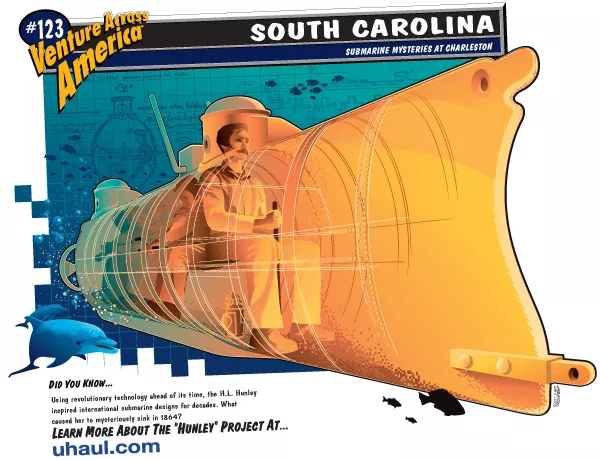
After a new volunteer crew was found, the men spent the next few weeks making adjustments to the submarine. It is during this time that the towed-torpedo design was replaced with the torpedo spar. In December 1863, the nearly ready Hunley sat on a dock in Mount Pleasant, South Carolina. A young artist named Conrad Wise Chapman came upon this unusual looking boat and was moved to sit down and begin sketching the machine in front of him. Chapman sketched a hydrodynamic vessel with a pointed spar sticking out from the bow. For more than a century, this drawing was considered inaccurate because most people did not believe that something this hydrodynamic could have been made with the limited resources available during this time period. It was not until the Hunley was raised 136 years later that it was determined how accurate Chapman had been.
February 17, 1864, was a cold and quiet night with the bright moon riding high in the sky. This was the night Dixon's crew had chosen for their attack. It was now only Dixon's crew, as Alexander had been called back to Mobile to work on another important project. Alexander would not be able to see the Hunley fulfill her destiny. The new crew felt confident this would be the night that the Hunley would fulfill her purpose and sink an enemy ship.
As the Hunley's crew silently propelled the submarine toward the USS Housatonic, the crew on onboard stood guard, watching for any sign of the fish boat that they had been hearing about. When a crewmember spotted something that resembled a porpoise coming toward the boat, most of the crew disregarded his concern. As the submarine got closer, the crew could see an eerie yellow glow coming from the deadlights on top of the sub. By the time the crew realized what they were seeing, it was too late. As the captain ordered the crew to open fire, the Hunley rammed her torpedo spar into the side of the USS Housatonic. The frantic crew fired as quickly as they could as the submarine appeared to back away from their ship. The Hunley was away from the USS Housatonic only about 50 to 80 feet, when they detonated the torpedo at the end of the spar. The crew was still shooting when they were knocked off of the deck by the explosion that blew a hole in the side of their ship. The ship went down quickly; fortunately for the crew, it had been anchored in only 25 feet of water, so most of the crew was able to climb into the rigging and wait to be rescued. The last view the crew got of the Hunley was of a strange blue light glowing from the portholes as it backed away from the sinking ship.
The USS Housatonic's crew did not know what the blue light meant; however to the crew onshore waiting for that blue light, it meant everything. That blue light was to be the signal that the Hunley had succeeded in her mission to sink an enemy ship. That would also be the last time that anyone would see the Hunley for over 131 years. The Hunley had succeeded in her mission and had become the first submarine to sink an enemy ship. But why didn't she make it back to shore after signaling success to shore? What had caused her to sink?