


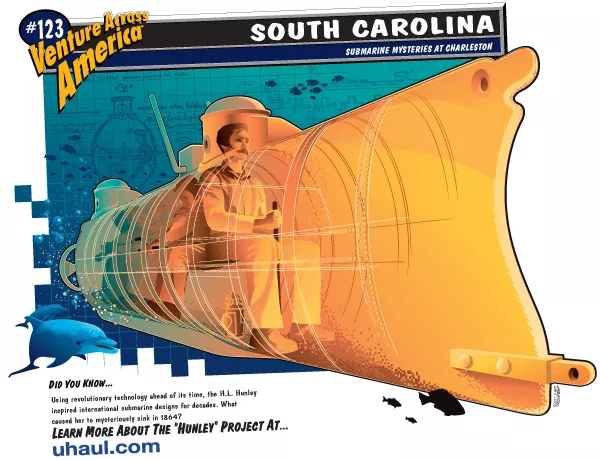
Like finding a needle in a haystack
Since the end of the Civil War, information-seekers, historians and treasure-seekers have scoured the area where the Hunley was supposed to have gone down, hoping to find the submarine. Because all information concerning the sinking of the sub went down with her on that cold night in February 1864, there would be no way to determine why she sunk until the wreckage could be found. However, it would take much more time than anyone could imagine.
In the early 1900s, P.T. Barnum of the Barnum and Bailey Circus offered a $100,000 reward to anyone who could determine the location of the mystifying submarine; however, no one was successful in claiming his prize. It was not until best-selling author Clive Cussler established the National Underwater Marine Agency (NUMA) in the late 1970s that there was hope of finding the lost submarine. On May 3, 1995, NUMA archaeologists Ralph Wilbanks, Wes Hall and Harry Pecorelli, put all doubts of finding the Hunley to rest when their magnetometer located a large metal object on the sea floor just off the coast of Sullivan's Island. The team had scoured the area off the coast of Charleston by dragging a magnetometer behind the NUMA boat. This magnetometer could detect anamolies on the ocean floor by taking readings of the magnetic readings below the ocean floor. Since the sub was made of iron, the magnetometer would be able to alert the NUMA to its whereabouts. They crisscrossed the ocean using a set of grid-like coordinates. Hall was the first member of the team to touch the Hunley in over 136 years. On that day in 1995, he dove down and felt through layers of silt built up through the years to touch the hinges of the hatch cover. The Hunley lay on her starboard side, with the bow pointing directly toward Sullivan's Island. She was pointing in the exact direction that she had been on the night she had gone missing.