


Innovative navigation
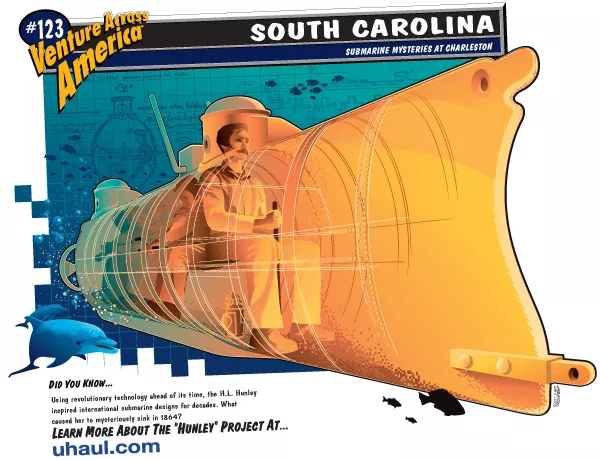
The H.L. Hunley was outfitted with navigational tools far ahead of their time. These innovative navigational tools made it possible for the Hunley to successfully pilot its way through the murky waters of the Atlantic with only a few small portholes available for the captain to use for sight. The captain would steer with a 27.6" vertical steering column, which operated almost like today's airplane joysticks. This device was the first of its kind, and it is likely that more modern vessels were modeled after its design. This steering mechanism could move only in two directions - port (left) and starboard (right). Maria Jacobsen, senior archaeologist of the H.L. Hunley Project stated that the steering mechanism is both "simple and elegant, representing a design for efficiency and space."
The device appears to be a part of both a well-designed and involved system of rods and cables that ran from the captain's area, through the interior of the vessel, underneath the crew bench and finally ending at the stern. Here, the connection would exit the submarine and connect to the exterior rudders which would allow the captain to turn the submarine to the left or right. To help the submarine dive and surface, dive planes were placed laterally on the outside of the sub. These planes were connected by a lateral rod which was adjusted by moving a lever inside the sub, at the captain station.
Finally, the most important part of the submarine's navigation would come into play. The crew would turn the crankshaft, causing the propellers to push the submarine forward or pull it backward, as the captain commanded.