




Beyond the Blue
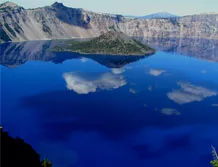
Wizard Island is a cinder cone that erupted after Crater Lake began to fill with water. It is one of two islands in Crater Lake.
Revisiting the Klamath Tribes stories about formation, Skell collapsed the top of Mount Mazama to imprison Llao forever beneath the world. He wanted peace and tranquility to cover up the seeping, dark hole, so he chose to fill it with the most beautiful blue water that anyone would ever lay eyes on. And so it has been that generation after generation, Crater Lake absolutely amazes visitors with its extraordinary color and remarkable clarity.
Crater Lake's breathtaking blue color is a product of several different factors: its great depths, the purity and clarity of its water, and the way solar radiation interacts with water. Research provided from Crater Lake National Park explains that water molecules in the lake absorb the longer wavelengths of light better, for example: reds, oranges, yellows and greens. This energy slowly heats Crater Lake throughout the summer. Shorter wavelengths, blue for example, are more easily scattered than absorbed. In the deep lake, some of the scattered light is redirected back up to the surface where we can see it. Around the edges of the lake, where the water isn't quite as deep, some of the unabsorbed green sunlight is also reflected back up. Crater Lake is known for changing colors on a day-to-day basis on account of varying wind, cloud cover and the angle of the sun.
Courtesy of Crater Lake National Park
One of Crater Lake National Park's most frequently asked questions is, "Why is Crater Lake so blue?" Experts explain that the water is so blue because there is hardly anything else in it - just water. Scientists at Crater Lake National Park indicate that while its not 100 percent pure water, it sure is close. Water molecules with little sediments, algae & no pesticides or pollution, will absorb all colors of the spectrum but not much blue. So, those wavelengths will scatter and make the water appear blue. The key is to have relatively pure water and lots of it. There needs to be enough molecules to absorb all of the other colors and, since Crater Lake consists of 4.6 trillion gallons of water, that can explain the extreme blue color of the water.
In an article titled "Crater Lake Clarity: It Doesn't Get Any Better Than This," aquatic biologist, Scott F. Girdner explains that in order to appreciate the lake's remarkable color and clarity, one must understand the relationship between ultraviolet (UV) light and the presence of dissolved organic matter in water. Girdner explains that in most lakes and oceans, dissolved organic matter, which comes from plants and animals in the water, limit the penetration of UV light. He also explains that only a small amount of organic matter dissolved in water is needed to absorb the UV rays, and because UV light is absorbed near the surface of the lake, aquatic organisms within Crater Lake are mostly protected from harmful UV Rays. Crater Lake consists of a very minimal amount of organic matter, so UV light is able to penetrate the lake. In fact, the levels of organic matter are so low that UV light is able to reach 320 feet below the surface. With this being the case, recent analysis of UV measurements have shown that in some months of the year, Crater Lake actually has greater UV transparency than any other known lake or ocean in the world.
Girdner explains that UV penetration is very important because of the recent changes in the Earth's ozone layer, climate changes and the impact of dissolved organic matter and corresponding fluctuations in underwater UV levels. Research being conducted at Crater Lake is important because it will help establish new UV absorption limits for pure water, and also will help determine the ecological factors that control the underwater penetration of UV light in lake and ocean ecosystems. Girdner states that further studies of UV light penetration will help ensure the preservation of Crater Lake, which he refers to as a precious gem.