




Early Exploration
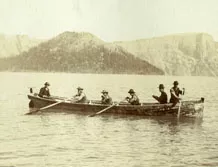
Courtesy of Crater Lake National Park.
It was springtime 1853 when 11 miners from California stopped by Isaac Skeeters' mercantile store in Jacksonville, Oregon, located about 90 miles southwest of Crater Lake. The miners were in need of supplies for a journey they were about to embark on. Loudly bragging back and forth, the miners were confident that they knew where and how to find the legendary Lost Cabin Gold Mine. A young man named John Wesley Hillman, who had recently returned home from a successful trip to the California gold fields, was financing the trip. Overhearing the men talk about lost gold mines, Skeeters quickly gathered up 10 fellow Oregonians and set out, basing the success of the journey on the miners' confidence he had overheard in his mercantile. On June 12, 1853, Hillman, along with two other members of his party, Henry Klippel and Isaac Skeeters, came upon a large body of water sitting in a huge depression while looking for the lost gold mine. Hillman exclaimed that it was the most beautiful body of water that he had ever laid eyes upon, and Skeeters suggested that the body of water be named Deep Blue Lake. After returning to Jacksonville, the men reported their discovery of the lake, but unfortunately at that time, people were more interested in finding gold, and the discovery of the lake was soon forgotten.
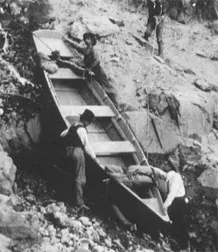
Courtesy of Crater Lake National Park.
The first published description of the lake came in 1862 after another party explored the Cascade Range around Mt. Mazama. The leader of the expedition, Chauncy Nye, later wrote a short article for the Jacksonville, Oregon Sentinel. In his article, he stated, "The waters were of a deeply blue color causing us to name it Blue Lake." However, the great depths of Crater Lake weren't explored until 1886, when William Gladstone Steel organized a party from the United States Geological Survey (USGS) and enlisted the help of geologist Clarence Dutton. Steel, Dutton and the rest of the exploration party carried a half-ton survey boat, named the Cleetwood, up the uninviting, steep slopes of Mt. Mazama and lowered it into Crater Lake. From the stern of the boat, the party used a piece of pipe on the end of the spool of piano wire to measure the depth of the lake from 168 different points. The party's deepest sounding came in at 1,996 feet, which was remarkably close to the next official measured depth of 1,932 feet, made by sonar measuring in 1953... and only 53 feet, or less than three percent off from the current, official measurement recorded with multibeam sidescan sonar in 2000.
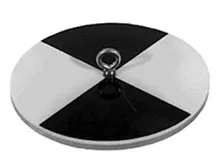
Courtesy of Crater Lake National Park.
Ten years after Steel and Dutton recorded the first depth measurements of Crater Lake, another crew of scientists set out to measure the lake's clarity for the first time. One of the crew members had a white dinner plate that he planned on using in order to measure the clarity. He attached the white plate to a rope and began to lower the plate down into the water. Once beneath the surface, the scientists watched until the plate disappeared into the darkness and they could no longer see it. At that point, they were able to use the length of the rope to record the first measurement of clarity. Since the initial measurement was recorded using the white plate, scientists have been using a black-and-white disk, known as a Secchi disk, to measure clarity. Crater Lake is the clearest measured natural body of water in the world. Records indicate that the clarity in August averages 98 feet (30 meters), but values as high as 142 feet (43 meters) have been recorded in the last two decades.