




Erupting History
Courtesy of Crater Lake National Park
Coming into existence roughly 400,000 years ago, Mount Mazama is part of the Cascade Range, a major mountain range located in western North America. The Cascade Range extends from southern British Columbia in Canada through Washington and Oregon, and into Northern California in the United States. Geologic research indicates that volcanic activity in that particular area is fed by subduction off the coast of Oregon. This is because the Juan de Fuca Plate slips below the North American Plate. The Cascade Range is topped by a series of volcanoes that were created as a direct result of heat and compression generated by plate movement, known as plate tectonics. The Cascade Range consists of large volcanoes, known as High Cascades, as well as various other smaller volcanoes. Mount Mazama came into existence much the same way as other mountains of the High Cascades did, as overlapping shield volcanoes, which are large volcanoes built almost entirely of lava flows. Mazama's overlapping cones were formed over time due to alternating layers of lava flow that eventually reached around 12,000 ft. in height.
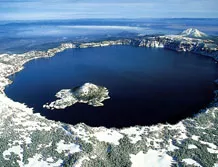
Seven thousand seven hundred (7,700) years ago, Mazama erupted violently, losing 2,500 to 3,500 feet in height. The eruption is estimated to have been 100 times greater in volume than the 1980 eruption of Mount St. Helens. Believed to be the most explosive eruption coming from the Cascade Range in the past one million years, Mazama expelled so much hot magma that the eruption actually caused the top of the mountain to collapse, creating what is known today as Crater Lake. Crater Lake lies inside Mazama's caldera (volcanic basin) that formed when the 12,000-foot-high volcano collapsed as a result of its massive eruption.