




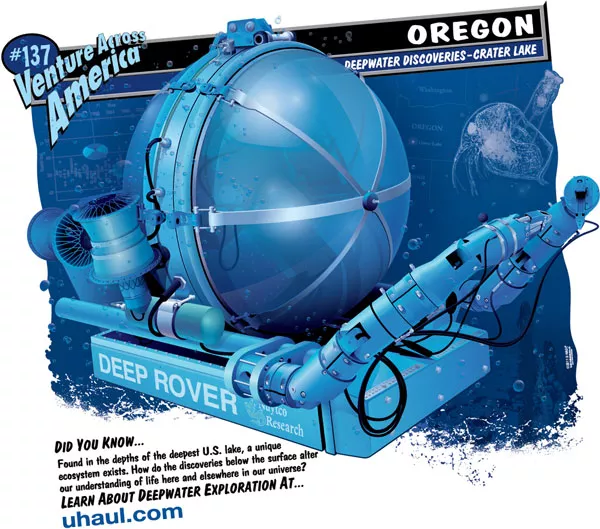
Into the Deep
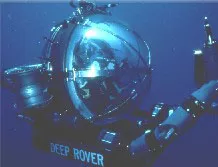
Courtesy of Crater Lake National Park
Once all systems were go, the operator was required to crawl through a narrow opening into the Deep Rover. The submarine hull was sealed after entering, and all outside noise would suddenly cut off. Buktenica realized on his first dive that upon being sealed shut, the Deep Rover heated up like a mini-greenhouse, and would typically reach up to 92 degrees Fahrenheit every time it was sealed. After receiving permission to leave the surface of Crater Lake on his first dive in the Deep Rover, Buktenica began the adrenaline-filled descent to the bottom of the deepest lake in the United States. The journey to the bottom took up to 30 minutes, during which time he was engulfed with nothing but blue until the blue simply turned black. Buktenica said the only sounds he heard while sinking into the dark depths was that of the creaking and popping from the Deep Rover as it adjusted to the increase in water pressure, along with the hum of carbon dioxide scrubbers cleaning the air.
Once Buktenica reached the bottom, he recalls taking a moment to reflect on the fact that he was the very first person to visit the deepest part of the lake, but knew that with only six hours allowed per dive, he needed to take care of business. Though the Deep Rover was designed to operate instinctively, Buktenica explained that many of the tasks he needed to perform required extreme concentration and were mentally challenging and physically demanding. Whoever was piloting the Deep Rover during a dive also was in charge of monitoring electrical and life-support systems, operating the submarine, collecting samples, recording observations on tape and film, and communicating with the surface boat via an underwater wireless telephone.
Deep Water Discoveries
Courtesy of Crater Lake National Park
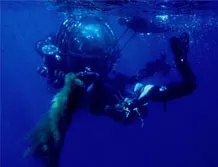
In Buktenica's aforementioned article, he reviewed the deep-water discoveries that he, Dymond and Collier made from their dives in the Deep Rover, and said that one of the highlights of the research was the discovery of bacteria colonies associated with hydrothermal fluids deep in the lake. The colonies formed yellow-orange mats which consisted of thousands of bacteria (Gallionella and leptothrix) that lived on chemicals in the hydrothermal fluids that slowly entered Crater Lake through lake sediments. According to Buktenica, it is unusual that the chemical energy from the fluids allowed the colonies to live in the darkness on the floor of the lake. Temperatures measured inside of the mats were as high as 68 degrees Fahrenheit in comparison to the rest of the water temperature, which was measured at 38 degrees Fahrenheit.
Dymond discovered and observed the first "blue pool," which he named Llao's Bath, after the Native American story Llao, chief of the Below World. These blue pools were discrete pools of saline water on the floor of the lake that had very distinct blue coloring, and looked like long bathtubs. Blue pools are composed of hydrothermal water with a salt content 10 times higher than the surrounding lakewater. The salt made the liquids in the pool heavier than the rest of the normal lakewater, and the pools appeared to be blue because of the optical properties of the chemically enriched fluids. The scientists were able to detect many chemical indicators of hydrothermal origin in the fluids taken from the blue pools. During their dives, the scientists continued to find other areas of hydrothermal activity in the depths of Crater Lake.
Courtesy of Steve Jessup
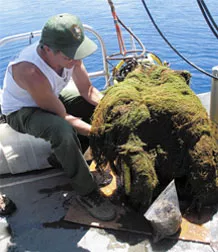
In addition to the hydrothermal studies, the Deep Rover also provided scientists with the unique opportunity to survey Crater Lake's floor for plants and animals and conduct geological surveys to learn more about the volcanic history of Mazama. Prior to the submersible studies with the Deep Rover, scientists were able only to collect samples and specimens from the lake's surface, along a shoreline or from shallow scuba dives. With the use of the Deep Rover, however, they were able to make some interesting underwater discoveries. One such discovery was that of a huge colony of moss (Drepanocladusa aduncus) living in the dark depths of Crater Lake that could quite possibly hold the record of being the oldest form of life in the World at between 4,000 and 7,700 years old. Collier explained that this could potentially be true; however, it can't be proven because deep moss is not just one organism. Growing at depths from 85 to 460 feet, the Deep Rover made it possible to see that deep moss hangs like icicles on underwater cliffs and forms underwater fields on smaller slopes. Buktenica explained that the discovery of the moss 460 feet below the surface was very remarkable, and was made possible because of Crater Lake's super-clear water. The water is so clear that sunlight is able to penetrate deep enough to allow growth of the unique, ancient deep moss. Animals also were discovered living beyond the blue, in the dark depths of Crater Lake at 1,932 feet below the surface of the water... another remarkable discovery because the water pressure that the animals had to live at was so extreme. Among the deepwater animals found were flatworms, nematodes, earthworms and the midge fly (Heterotrissocladius).
Courtesy of Crater Lake National Park
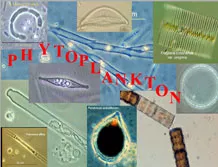
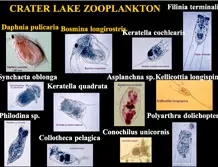
Scientists also discovered 157 species of phytoplankton and 12 species of zooplankton in the depths of Crater Lake. Plankton are free-floating, drifting microscopic organisms that live in saltwater or fresh water. Scientists again determined that the unusual depths in which these organisms were able to survive was a direct result of lake clarity, which allows sunlight to reach so deeply beneath the surface. Scientists at Crater Lake explain that the density and diversity of these life forms is restricted because of the low concentration of nitrogen in the lake; however, different forms of plant and animal plankton live at different depths, down to around 600 feet below the water's surface.
Courtesy of Crater Lake National Park
It's back! Scientists were happy to report that Crater Lake's largest zooplankton, Daphnia pulicaria. returned to the lake after having been absent for eight years. Scientists realized that the return of Daphnia in high abundance was a direct result of fewer fish in the lake. Daphnia disappeared almost completely in 1991, and then again in 2000, due to the increase of kokanee, a particular type of fish living in Crater Lake. Kokanee ate the zooplankton and other small invertebrates, which ultimately reduced the amount of Daphnia and other zooplankton in Crater Lake. Daphnia is important at Crater Lake because when its levels decrease, the food chain is adversely affected. Now that we know more about Crater Lake and some of unique things existing in its depths, let's learn how some particular discoveries below the surface can alter our understanding of life elsewhere in our universe.