




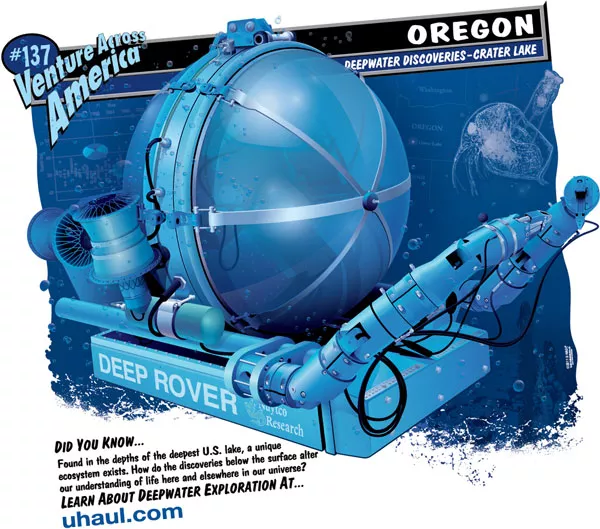
World-Class Laboratory
Girdner, Buktenica and Gary Larson compiled research into an annual report and detailed trend analysis called, Crater Lake Long - Term Limnological Monitoring Program, which can be found on the Crater Lake Institute website: craterlakeinstitute.com. Their report evaluates long-term trends in Crater Lake's physical, chemical, biological and climatological dataset (collection of data) and attempts to identify possible reasons for trends using statistical inferences between datasets and comparisons to other lake studies. The analysis is informative and provides a lot of data, with an overview and look into various operations, methods, results, discussions and other special projects that have and are currently taking place at Crater Lake. Crater Lake National Park provides scientists and park managers with a gauge for assessing changing environmental conditions external to the park, and the long-term monitoring of Crater Lake has allowed scientists to develop information about Crater Lake's natural dynamics and complexity. Scientists explain that the data will serve as a reference when studying the impacts of climate change, and the effects of human activities, such as agriculture and urban growth, on other lakes. For the last two decades, scientists have teamed up with the USGS, the NPS and Oregon State University to study Crater Lake. Authorities from Crater Lake National Park have stated that long-term monitoring of the lake has been a priority for them for some time, and will continue far into the future.
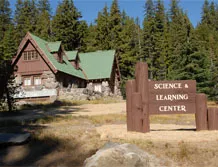
Courtesy of Crater Lake National Park
Known by many for being one of the world's most extraordinary landscapes, a little-known fact that visitors aren't always aware of is that Crater Lake also serves as a one-of-a-kind outdoor classroom. Crater Lake has been referred to as a "world-class" laboratory for studying lakes because of its pristine condition. Scientists, teachers, students and artists are all welcome to visit Crater Lake's Science and Learning center to investigate, instruct and learn from what the park has to offer. Crater Lake National Park welcomes those who can lend their talents, share their discoveries, and teach lessons with the hope of inspiring generations to come to continue to explore and learn more about what Crater Lake has to offer.
Wizards, Phantoms and Dragons...Oh My!
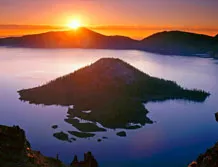
Courtesy of Crater Lake National Park
Along with its majestic setting and extraordinary surroundings, Crater Lake also features enigmas and ironic anecdotes. After the cataclysmic eruption of Mt. Mazama more than 7,700 years ago, smaller volcanic eruptions continued... which caused cinder cones to form on the crater's floor, far below the surface of the lake. One cinder cone managed to reach the surface and actually extend 2,700 feet above Crater Lake's deepest point. Back in 1885, Steele, after seeing it for the first time, dubbed the cinder cone Wizard Island because he thought it looked like a wizard's hat. According to Native American stories, Wizard Island really is Llao's head. After the mighty Skell defeated Llao, he threw Llao's body back into Crater Lake, where it would remain buried forever. Steele also named the crater at the top of Wizard Island, calling it the Witches' Cauldron. Today, the cinder cone and crater are still referred to and known as Wizard Island and the Witches' Cauldron. In addition to these unique names, Crater Lake also has features known as The Devil's Backbone, Llao Rock, Llao Bay and Skell Channel.
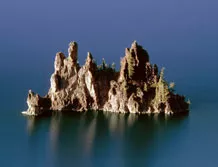
Courtesy of Crater Lake National Park
Perhaps one of the most remarkable features of Crater Lake is the infamous Phantom Ship Island. The silhouette of the island closely resembles a sailing ship; however, it was dubbed "phantom" because the island tends to disappear into thin air, only to reemerge later on. It has been suggested that this effect is the result of different viewing perspectives, lighting and weather conditions; however, imaginations tend to run wild with this enigma. Phantom Ship Island is part of a 400,000-year-old formation known as "The Phantom Cone," the first major volcanic eruption that occurred before Mt. Mazama blew its top.
Many creature-sighting stories and myths have surfaced over the years; however, the most recent sighting story was told in 2002 by a woman who recalled seeing something very strange in the waters while visiting Crater Lake as a child. According to the woman, she and her friends were on the water in a rowboat when something she remembers being a block long, swam beneath their boat and terrified them. When telling the story, she recalled never having been so scared in her life, saying what she saw swim below her that day was a dragon! She also stated that she knows why Native Americans say monsters live in the lake--because they do, and she saw one with her own eyes.
The infamous Crater Lake creature even made it to Hollywood in 1977 with the production of a film titled "The Crater Lake Monster." The movie begins with a meteor from outer space crashing into the waters of Crater Lake and leaving a giant egg, which subsequently hatches. After hatching, the creature traveled in and around the lake's waters, making meals out of unsuspecting campers. And though the film is called "The Crater Lake Monster," filming did not take place at Crater Lake, and the lake used didn't resemble Crater Lake at all. But with that said, every lake has to have a monster, right?