




Majestic Crater Lake
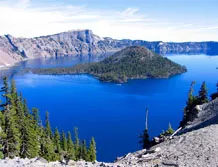
Courtesy of Crater Lake National Park
Crater Lake National Park (National Park Service, United States Department of the Interior), reports that at nearly 2,000 feet deep, approximately 1,943 feet at its deepest point, Crater Lake is the deepest lake in the United States, second deepest in North America and the ninth deepest in the world. However, if one were to compare Crater Lake's average depth of 1,148 feet to the average depth of other deep lakes, Crater Lake then becomes the deepest in the Western Hemisphere and the third deepest in the world.
Averaging more than five miles in diameter, Crater Lake is surrounded by steep rock walls that rise 2,000 feet above the surface of the lake. Crater Lake averages around 528 inches of snow per year and exists almost entirely because of pure snowfall, which provides the lake with water. Crater Lake has no inlets or outlets, so evaporation or seepage prevents the lake from becoming any deeper. Lake levels do fluctuate slightly from year to year, which is common with all lakes around the world. Crater Lake's highest recorded level was measured in 1975 when the lake's surface reached a height of 6,179.34 feet above sea level. The lowest level was recorded in 1942 when it was at 6,136.20 feet. Showcasing just how deep Crater Lake actually is, scientists from Crater Lake National Park created a picture of the Eiffel Tower (985 feet), Washington Monument (555 feet) and the Statue of Liberty (305 feet) stacked on top of one other in the deepest point of the lake. If that really could be done, there still would be more than 100 feet of water covering Liberty's torch. Now that's deep!
Crater Lake was formed when a massive eruption of Mount Mazama 7700 years ago caused the mountain to collapse, leaving a steaming caldera. Centuries of rain and snow filled the caldera creating Crater Lake.
Crater Lake's temperatures vary between 32 degrees Fahrenheit (0 degrees Celsius) and 66 degrees Fahrenheit (19 degrees Celsius) at the surface. More than 260 feet beneath the surface, the water remains 38 degrees Fahrenheit (3 degrees Celsius) year round. The surface of Crater Lake rarely freezes during the winter months because of the large amount of heat stored within the lake during summertime, windy surface conditions and relatively mild air temperatures. The Crater Lake National Park Service recalls the most significant complete freezing event in recent history occurred between January and April 1949.
It certainly is not easy for those visiting to have the pleasure of casting their eyes on Crater Lake's majestic beauty. In order to do so, one must hike up the slopes of Mt. Mazama, first dodging the remnants of its angry volcanic past scattered about, then climbing steep, forested slopes.... all before reaching the rough-edged rim of its ancient caldera hundreds of feet above its water's surface. Yet, year after year visitors from around the world continue to take the challenging journey up Mazama in order to see Crater Lake's beauty. Not surprisingly, after reaching the rim, reactions remain the same generation after generation. Below are some early passages that clearly describe the breathtaking beauty of Crater Lake.
"As the visitor reaches the brink of the cliff," geologist Clarence Dutton promised in his 1886 essay on Crater Lake published in Science, "he suddenly sees below him an expanse of ultramarine blue of a richness and intensity which he has probably never seen before, and will not likely see again. Lake Tahoe may rival its color, but cannot surpass it... It is difficult to compare this scene with any other in the world, for there is none that sufficiently resembles it."
Author Zane Grey wrote in 1919, "I expected something remarkable, but was not prepared for a scene of such wonder and beauty... Nowhere else had I ever seen such a shade of blue... How exquisite, rare, unreal!"