




Deep Rover Submersible
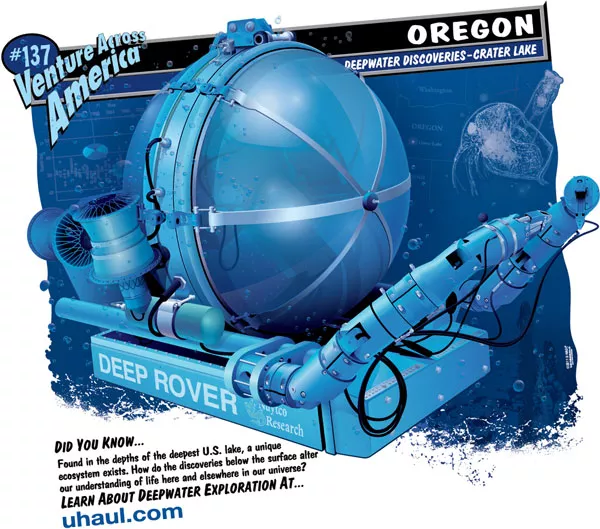
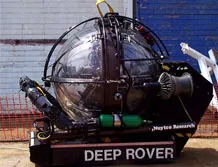
The U-Haul SuperGraphic representing the state of Oregon features the Deep Rover submersible. The Deep Rover is a highly technical submarine that the National Park Service (NPS), National Geographic Society (NGS) and the United States Geological Survey leased from Canada Dive Inc. in order to explore the uncharted depths of Crater Lake. Nuytco Research Ltd., a sister company of Can-Dive, Inc., owns the Deep Rover submersible, and is a world leader in the development and operation of undersea technology. Nuytco and its sister company, Can-Dive Construction, Ltd., have more than 30 years of experience working around the world. Nuytco designs, builds and operates atmospheric diving suits, submersibles and remotely operated vehicles, as well as specialty equipment for commercial diving. Can-Dive is a diving company offering state-of-the-art diving technology and services with a reputation solidly built on underwater innovation and satisfied customers. Dr. Phil Nuytten, Nuytco's president and founder, is recognized as one of the pioneers of the diving industry. His current work is aimed at advancing the concepts of deep work in the oceans by using of one-atmosphere vehicles and tools. Nuytco Research provides a system description of the Deep Rover submersible.
| Pressure Hull: | Two 160 degree, five inch thick acrylic plastic hemispheres, joined by two aluminum rings to form a single sphere, 64 inches O.D. |
| Power Source: | Two pressure compensated battery pods provide 120 v. each. Emergency power provided in seat base. Can be surface powered via umbilical. |
| Maneuvering Control: | Four 1 h.p. innerspace thrusters. Two rear thrusters fixed, two forward thrusters rotatable. All thrusters can be independently activated. Bouyancy provided by a single soft tank, providing 150 pounds bouyant lift. |
| Life Support: | Oxygen carried externally in two 80 c. ft. tanks. Carbon dioxide removed by absorbent scrubbers. Emergency lung powered scrubber also available. Emergency breathing gas via air BIBS. |
| Viewing: | Panoramic, via plastic pressure hull. |
| Sonar: | One scanning sonar. |
| Manipulators: | Two five function, sensory feedback type, with variable geometry and options. Wrist mounted lights, video, and still cameras standard. |
| Communications: | Surface: VHF Sub-Surface: Standard UQC and 18 KHZ |
| Classification/ Certification: |
Lloyds Register of Shipping |
| Optional Equipment: | 27 KHZ directional hydrophone, direction finder/transmitter, tracking beacon, Xenon strobe, hydraulic cutters/tools, sampling equipment, jetting/dredging pumps. Real time video and sonar data may be supplied when operated in tethered mode. |
Deep Rover Revealed
Courtesy of Nuytco Research Ltd.
Did you know that Algaphogopsis, also known as the Crater Lake Mite, is a microscopic animal that lives in the waters of Crater Lake?
Aquatic ecologist, Mark Buktenica, actually has had the privilege of conducting 17 dives in the Deep Rover, and he explains that Crater Lake is no stranger to scientists conducting research in regard to the physical, chemical and biological properties of its waters, considering that such studies have been taking place for more than a century. However, it wasn't until 1986 that Congress ordered the NPS to start investigating more, which prompted the study of the park's hydrothermal resources. Buktenica recalls that a geothermal energy company was drilling wells adjacent to the park boundary, evaluating whether or not there was potential for any geothermal energy development. The new requirements for further investigation into the depths of Crater Lake were passed right around the same time. Geothermal energy is thermal energy generated and stored in the Earth. Thermal energy is energy that determines the temperature of matter. The Earth's geothermal energy originates from the original formation of the planet, radioactive decay of minerals, volcanic activity, and solar energy absorbed at the surface.
Courtesy of Crater Lake National Park
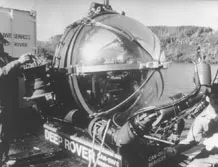
As a result of Congress's request to the NPS, the 7,000 pound, one-person Deep Rover and 30,000 pounds of additional scientific and technical support equipment were flown into Crater Lake by helicopter to begin conducting hydrothermal studies. Other studies using the Deep Rover were also initiated at the same time in order to explore Crater Lake's deepwater plants, animals, and early volcanic activity. Buktenica explained that learning how to operate the submersible required an intense one-week training program that included field work and classroom instruction in operation, safety and emergency response. All of this required knowledge was to ensure that he and two other Oregon State University oceanographers and principal hydrothermal investigators, Dr. Jack Dymond and Dr. Robert Collier, would be ready to go when it was time for the dives to commence in 1988. Having since conducted 17 successful dives in the Deep Rover, Buktenica wrote an article summarizing the results and observations from hydrothermal, biological, and geological submersible studies at Crater Lake National Park from 1988-1989 called, "Why Enter a Sleeping Volcano in a Submarine?" He opens the article with the following passage:
"I was sitting alone in Crater Lake, 600 feet underwater in a small submarine called Deep Rover. I had just completed collecting rock samples along an underwater edge of Wizard Island, and I had 135 pounds of rocks in a basket attached to the front of the submarine. Unknown to me at the time, a couple of O-ring seals were leaking throughout the dive. Water seeping through the seals into the submarine, combined with condensation from my breathing, created an uncomfortable amount of water on the floor. My feet were near the front of the vessel, and as I prepared to start to the surface with the rocks, the submarine tilted forward. As the submarine tipped, the water level at my feet rose rapidly, giving the distinct impression that the submarine was filling with water. Garbled and intermittent communications with the surface crew aggravated the situation. Everyone operated expertly and efficiently; Deep Rover and the rock samples were recovered smoothly. Actual dangers and repairs turned out to be minimal, and the submarine dove again the next day. Nonetheless, I thoroughly reviewed emergency procedures at my first opportunity."